

Affinity Moving · November 28, 2026
? All articlesCustom crating is a rigid wooden enclosure built to the exact size of one item, and it earns its cost when a piece is fragile, awkwardly shaped, heavy or hard to replace. A framed painting, a grandfather clock, a sculpture or a piano can travel safely in blankets and boxes on a short local move. Over a long route, with several handoffs or storage in between, a crate is often the better protection. The decision comes down to three things: what the item is worth, how far and through how many hands it travels, and what your mover’s liability covers if something goes wrong. We are a licensed and insured Minneapolis moving company, and this guide walks through each of those so you can decide before the estimate arrives.
TL;DR
- A custom crate is built around one item, with rigid walls and shock-absorbing lining. Blankets and cardboard only cushion the surface.
- Crating makes the most sense for fine art, antiques, electronics, instruments and other pieces that are fragile, irregular or expensive to replace, especially on long-distance moves.
- Planning ranges for a household crate run from roughly $80 for a small basic crate to $800 or more for fitted crates, with larger and heavier pieces costing more.
- Standard mover liability is only 60 cents per pound per article unless you choose full value protection, so a heavy, valuable item can be badly under-covered.
- Tell your mover about every special piece when you request the written estimate, so crating, handling and timing sit in one plan.
Table of Contents
- What custom crating is, and how it differs from packing
- Which belongings are worth crating
- What custom crating costs
- Why liability makes crating more important
- How to plan a crated move, step by step
- Crating for different kinds of movers
- Choosing a mover for a crated move
- Plan your special pieces with us
- FAQ
- Sources
What custom crating is, and how it differs from packing
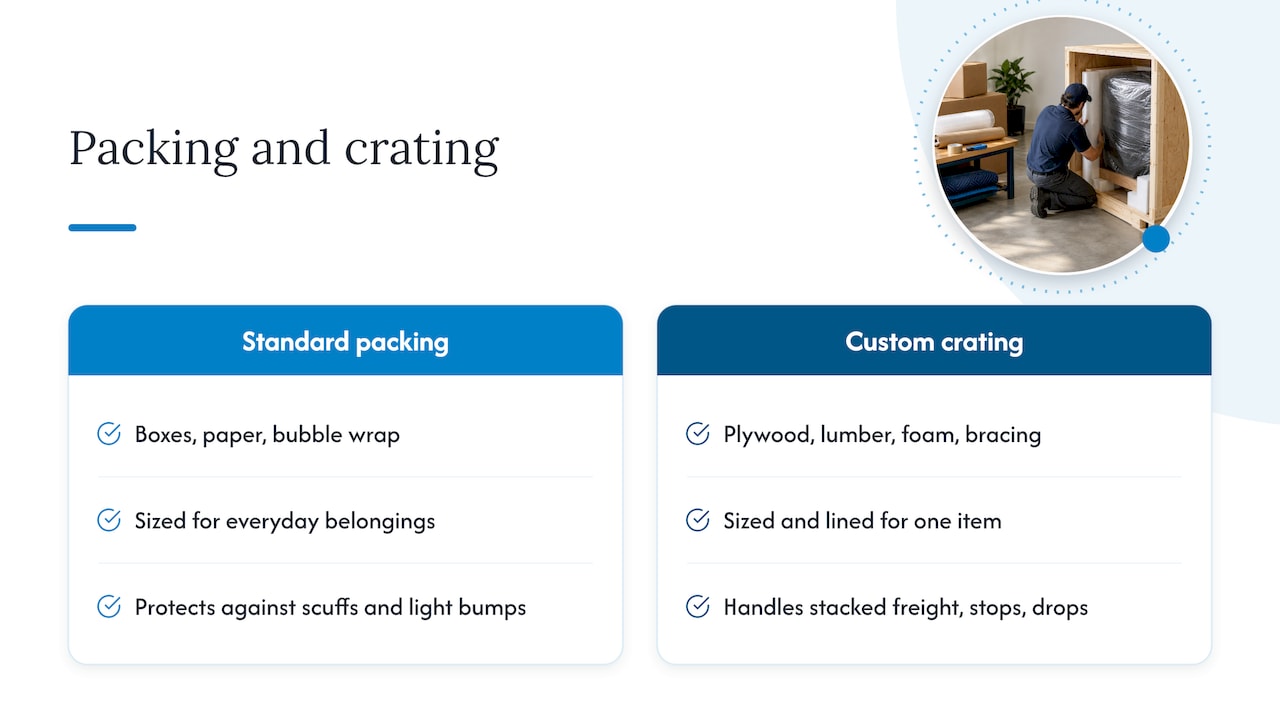
Standard packing means boxes, paper, bubble wrap and moving blankets. Those are sized for everyday belongings and protect against scuffs and light bumps. Custom crating is a different category: a rigid enclosure, usually plywood and lumber with foam and interior bracing, sized and lined to fit one item rather than mass-produced for many.
The practical difference is how each one handles force. A blanket wrap is flexible and covers the surface. A crate takes the load itself: stacked freight, a sudden stop, a drop from a lift gate. The item inside is held in place so it cannot shift. This Old House explains that crates are designed to match each item for a snug, secure fit that prevents shifting during transport, protection that standard packing and shipping services don’t include.
Crates are also reusable in many cases. If you expect to move the piece again, or send it to storage and bring it back, a well-built crate can serve for future moves too.
What a well-built crate looks like
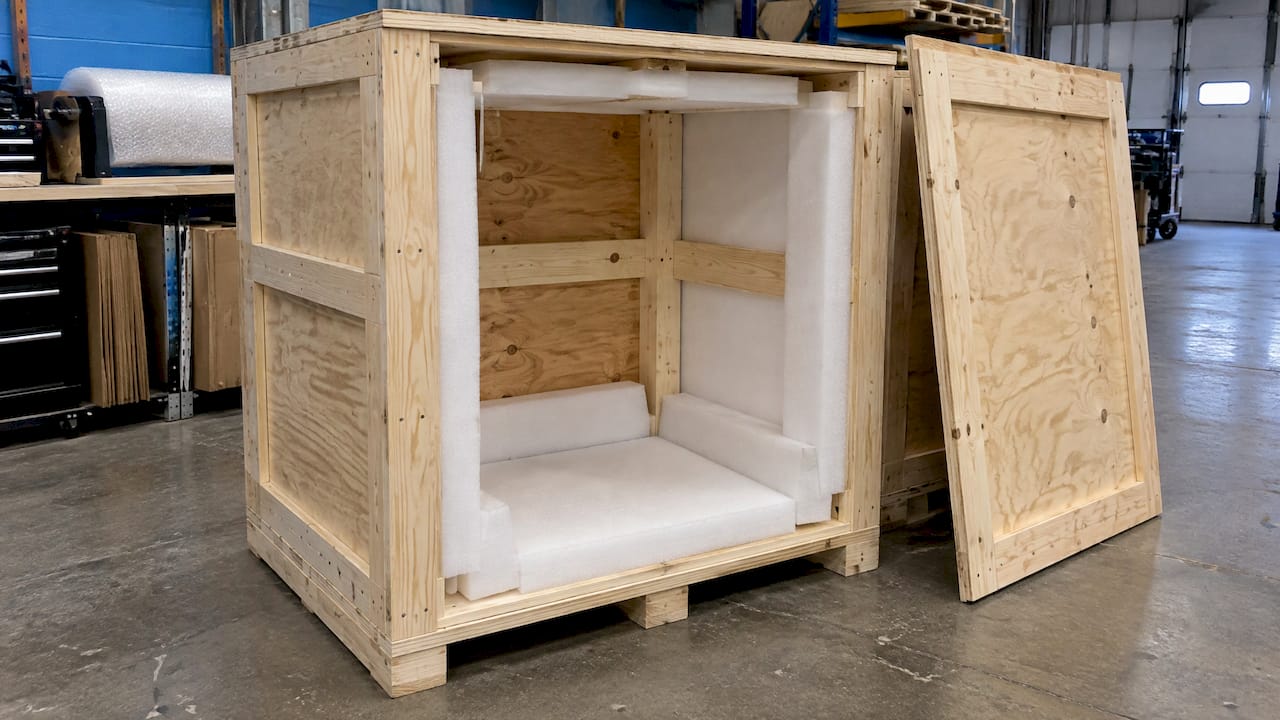
Specifications vary by item, but a typical household crate follows a recognizable pattern. According to one industry guide, a specialist measures the item, assesses its surface sensitivity and weight, then designs a crate with about three inches of cushioning on all six sides. Frames are commonly built from 2x4 lumber with 3/4-inch plywood panels, joined with screws rather than nails so the crate can be opened without stress to the contents. The outside carries orientation and handling markings so everyone who lifts it knows which way is up.
You don’t need to memorize those numbers. They are useful for one reason: they let you judge whether a crate quoted to you is a real item-specific enclosure or a box with extra tape.
Which belongings are worth crating
Not everything in your home needs a crate. The categories that most often do share one trait: damage would be expensive or impossible to reverse.
- Fine art and mirrors. Large paintings, framed prints, sculpture and oversized mirrors have fragile surfaces and edges, and glass can shatter under flex. Antiques and fine art lead the list of items that should be crated.
- Antiques and heirlooms. Veneer, inlay, carved details and old joinery do not forgive pressure or vibration.
- Electronics and medical devices. Large televisions, studio equipment and sensitive instruments benefit from fitted foam.
- Pianos and instruments. Heavy, tall, tuned and top-heavy, they are a classic candidate on long routes.
- Business assets. Trade show displays, lab equipment, specialty machinery and high-value office pieces often warrant a crate during an office relocation.
The choice of crate material and style depends on weight, fragility, distance, climate and budget. Wood is most common for household moves, with plastic or metal used for some equipment.
A simple value test
Industry guidance frames crating as a cost-benefit decision rather than a rule. One guide suggests it is strongly indicated when an item is fragile or irreplaceable and worth more than about $2,500, when the trip involves air, ocean freight or several carriers, or when the standard liability cap would not cover the loss. The same guide notes that crating may be skipped for dense, solid, non-fragile items on short local moves where the same crew keeps the item the whole time.
That gives you a workable way to sort your belongings:
- Crate it: high value, fragile or irregular, long route or storage.
- Pad and wrap it professionally: valuable but sturdy, or fragile but moving a few miles in one truck.
- Box it normally: everything with a modest replacement cost.
Route and handling matter as much as value. Museum conservation research cited by one cost guide suggests that overbuilt crates add cost and handling burden, and that the right level of protection depends on the route and handling chain, not on using the most wood possible. In plain terms: match the protection to the trip. The same logic applies to other valuable cargo, and a cost-benefit approach based on route, handling and item value is how collectors think about shipping a vehicle.
What custom crating costs
Crating is priced per item, not per move, and the price follows the size of the crate and the complexity of the build. Published figures are planning ranges rather than quotes, and they vary by region and by who builds the crate.
One 2026 guide gives these planning ranges for crates:
| Crate type | Typical planning range |
|---|---|
| Small basic crate | $80 to $180 |
| Full plywood crate for art or a mirror | $200 to $550 |
| Fitted crate for sculpture or irregular antiques | $400 to $800+ |
| Oversized or heavy equipment crate | $600 to $2,000+ |
Freight and insurance are usually separate from those figures. Another 2026 analysis of moving surcharges puts custom wooden crates at $150 to $400 per item, with consumers often spending $300 to $600 on specialty pieces such as oversized artwork, grandfather clocks and pool tables.
What moves the price
- Outside dimensions and weight. Bigger and heavier means more lumber, stronger framing and more labor.
- Surface vulnerability. Gilded frames, glass, bare stone and fresh paint call for more lining.
- Shock and vibration exposure. A cross-country route with transfers needs more than a cross-town trip.
- Reuse. A crate built to be used repeatedly costs more to make than a single-use one.
- On-site versus shop build. Building at your home takes more of a crew’s time than building in a shop.
- Export rules. Regulated solid wood going abroad needs ISPM 15 treatment and an official mark, which the USDA requires. This does not apply to ordinary domestic ground moves within the US.
A useful habit is to compare the crate price with what you would lose. A $300 crate around a piece that would cost $4,000 to replace is a small share of the risk. The same $300 around a $60 lamp is not.
Why liability makes crating more important
Many people assume their mover’s insurance covers the full value of what they own. It does not by default. Under federal rules, the basic option on interstate moves is the waiver of full value protection, where the mover is liable for no more than 60 cents per pound per article. The Federal Motor Carrier Safety Administration publishes this in its guide for people who are moving.
Here is what that means with a worked example. A 40-pound framed painting valued at $5,000 would be covered for $24 under the 60-cent rule. A crate lowers the chance of damage, and full value protection changes what is paid if damage still happens. The two work together, and we cover the second one in our guide to avoiding 60-cent-per-pound payouts.
Before you sign, read the estimate for the liability option you are choosing and make sure each special item is named on it.
How to plan a crated move, step by step
1. List the pieces that may need a crate
Walk through your home or office and note anything that matches the categories above. Write down approximate dimensions, weight, the material and a replacement value. Photos help. Include items stored in basements, garages and storage rooms, because those are the ones people forget until moving day.
2. Decide by route and value
A short local move with one crew is a different risk than a long-distance move with a storage stop. Apply the value test from earlier. If an item is irreplaceable, protect it for the worst part of the trip, not the average part.
3. Request a written estimate that names each item
A vague estimate hides crating costs until the day of the move. Our written estimates consider size, access, distance and timing, so the more detail you give us about your special pieces, the more complete the plan you receive. Mention stairs, narrow doorways, elevators and parking, since a crated item is larger than the item alone and access affects how it moves out of the building.
4. Allow lead time
A custom crate is built to order, so it cannot be produced an hour before the truck arrives. Raise crating early, ideally when you first request your estimate, and schedule it ahead of the loading date so the item is ready and secure.
5. Prepare the item
Remove loose parts, take mirrors and glass out of their wall mounts, and photograph the condition of each piece. For items that go inside a crate, our guides on packing artwork safely, packing mirrors and packing fragile items and jewelry explain what goes against the surface first.
6. Confirm the move-day plan
Check who is handling each piece, how it will be loaded and secured in the truck, and where it will be placed at the destination. Keep the paperwork that lists each crated item.
7. Unpack and inspect
Open crates at the destination while the crew is still there where possible, and compare the condition of each piece with your photos. If something is damaged, note it on the paperwork right away.
Crating for different kinds of movers
Homeowners. The usual crate candidates are art, antiques, a grandfather clock, a large mirror or a piano. Group them in your estimate request so they are planned together instead of discovered on moving day. Our guides to moving artwork with museum-grade packing and antique furniture moving show the steps around a crated piece.
Businesses. Offices have their own fragile assets: servers, specialty displays, framed lobby art, lab and imaging equipment. Crating those pieces protects them while the rest of the office moves quickly, which matters when you are trying to keep downtime low.
Students and apartment renters. Most student moves need no crates at all. A large television or a framed print can usually be handled with proper boxes and padding, so save crating for the one or two things that cost real money to replace.
Families. If you are packing and unpacking with limited time, the crate decision is one of the first to make, because it affects scheduling for everything else.
Choosing a mover for a crated move
Before booking, you want clear answers to these questions:
- Is the mover licensed and insured, and can it explain what that covers for your items?
- Does the estimate name crated pieces and list their costs?
- What liability option applies, and is it full value protection?
- Who handles the piece at every stage?
- What happens if access at either address is tight?
Federal rules also let you check a mover’s registration before hiring. Our guide to hiring specialty movers safely walks through the FMCSA checks homeowners and businesses can run.
Our perspective on crating
A crate is one decision inside a bigger plan, not a separate purchase. Customers come to us worried about one painting, one piano or one heirloom desk, and the real question is how that item travels from its current spot to its new one with the least risk and no surprises on the day.
That is why we put everything in a written estimate. Our estimates take size, access, distance and timing into account, and our approach is to give you clear move details well in advance, so the specialty piece is not an afterthought on moving day. Our trained, licensed and insured crews are focused on careful handling, and our specialty services cover pianos, antiques and artwork alongside packing and furniture disassembly and reassembly.
Our advice is simple: decide which two or three items you could not replace, tell us about them first, and build the move around them.
Derrick
Plan your special pieces with us
If you are moving in Minneapolis or the Twin Cities, or heading farther, tell us about your fragile and high-value items when you ask for your written estimate. Our specialty moving services cover pianos, antiques and artwork, and our packing services include materials and full packing, so the whole move can follow one plan from quote to move day. For a long haul, see our long-distance moving services.

You can request a free estimate with the details of your move and your special pieces.
FAQ
What is the difference between packing and crating?
Packing uses boxes, paper and blankets to cushion belongings against everyday bumps. Crating builds a rigid enclosure to the exact size of one item, with lining on every side, so the item cannot shift and the walls take the impact. Packing suits most of your household. Crating suits the few pieces that are fragile, heavy or hard to replace.
How much does custom crating cost for a move?
It depends on size, weight, fragility and who builds it. One 2026 guide gives planning ranges from about $80 for a small crate to $600 or more for oversized equipment. Freight and insurance are usually separate, so ask for the crate to be listed as its own line on your written estimate.
Do I need a crate for a local move?
Not always. On a short local move with one crew handling the item from start to finish, careful padding and wrapping is often enough for sturdy pieces. A crate is worth considering for irreplaceable, fragile or very valuable items, and for anything going into storage or on a long route.
Does mover insurance cover a crated item at full value?
Not automatically. The basic federal option limits liability to 60 cents per pound per article, which is far below the value of most art and antiques. Ask for full value protection and confirm each valuable item is named on your paperwork.
Sources
- What Is Custom Crating? (This Old House)
- Crating and Custom Packaging for High-Value Items (National Moving Authority)
- Custom Crating Cost for Moving 2026 (Moving-Calculator.net)
- 2026 Accessorial Charges (MoveCost)
- Your Rights and Responsibilities When You Move (FMCSA)
- Classic Car Transport Service: A Collector’s 2026 Guide