
Affinity Moving · November 24, 2026
? All articlesUse a dish pack for plates, bowls, glasses and anything else in your kitchen that breaks. Use regular boxes for everything that doesn’t. A dish pack is a double-wall carton, built thicker and taller than a standard box, because dishes fail in two ways: crushing from above and shock from the side. A regular box is built for bulk and weight, not for brittle ceramics. If you would rather not pack the kitchen at all, our crews handle it as part of our packing services.
This guide covers what actually differs between the two boxes, which items go where, how paper compares with peanuts as cushioning, and how to fill each box so nothing rattles.
TL;DR
- A dish pack has thicker, double-wall board and more height, so it absorbs shock and lets you wrap each piece fully. A regular box is a single wall and suits sturdier items.
- Put plates, bowls, stemware, mugs and china in dish packs. Put pots, pans, plastic ware, linens and small appliances in regular boxes.
- Wrap every piece first. In one published shipping test, no single material protected dishes on its own.
- Pack plates on their edges, heaviest items at the bottom, and fill every gap with crumpled paper so the box does not rattle.
- Keep any box, dish pack included, light enough to lift safely. Movers recommend staying under 50 pounds.
Table of Contents
- What actually separates a dish pack from a regular box
- Which items go in a dish pack, and when a regular box works
- Packing paper vs. packing peanuts
- How to pack a dish pack so it doesn’t rattle
- Planning how many boxes you need
- Special situations: apartments, offices and storage
- When to let the movers pack it
- Packing help from Affinity Moving
- Our view on dish packs
- FAQ
- Sources
What actually separates a dish pack from a regular box
The two boxes look like cousins, but they are built for different jobs.
Construction. A regular moving box is single-wall corrugated cardboard: one fluted layer between two flat sheets. A dish pack is double-wall, with two fluted layers and three flat sheets. The extra layer makes the walls stiffer and gives them more room to crush gradually instead of transferring a bump straight to what’s inside. Boxes are graded by edge crush strength, which is how much force the board takes along its edge before it gives way. That rating matters most when boxes are stacked on a truck, because the bottom boxes carry everything above them.
Shape. Dish packs are usually close to square on the base and taller than most standard boxes. The height is useful, not decorative. It means you can wrap a glass in paper, stand it up, and still have room for a cushioning layer above and below without squeezing the lid down on top of it.
Handles and dividers. Many dish packs have built-in hand holds. Many also pair with a divider kit, cardboard cells that keep each glass or cup from touching its neighbor. Dividers are the reason a dish pack suits stemware so well: the most common way a glass breaks in a box is by hitting another glass.
Weight. A box full of ceramics gets heavy quickly. Double-wall board can carry more, but you are still the one lifting it. Our own guidance on keeping boxes under 50 pounds applies to dish packs too. A stronger box is not a reason to overload it.
Here is the short version side by side:
| Dish pack | Regular box | |
|---|---|---|
| Wall | Double-wall corrugated | Single-wall corrugated |
| Best for | Plates, bowls, glasses, china, mugs | Pots, pans, linens, books, small appliances |
| Cushioning | Paper wrap plus paper fill, dividers optional | Paper wrap for any breakables you include |
| Stacking | Holds up to heavy loads when full | Fine for light and medium loads |
| Cost per box | Higher | Lower |
| Risk if misused | Overweight and hard to lift | Crushed or cracked contents |
The cost gap is real but small compared with replacing a set of dishes. If you are moving a full kitchen, a handful of dish packs is the cheapest insurance in the whole move.
Which items go in a dish pack, and when a regular box works
A useful rule: if it can chip, crack or shatter, it goes in a dish pack. If it can only dent, scratch or squash, a regular box is fine.
Dish pack items
- Dinner plates, salad plates and saucers
- Bowls, including nesting bowls
- Mugs and cups
- Stemware, wine glasses and tumblers (use dividers or generous paper)
- Fine china and everyday stoneware
- Glass serving dishes, ceramic casseroles and gravy boats
- Small, fragile decor from the kitchen, such as a ceramic cookie jar
For wine glasses, decanters and bar glassware, we have a separate walkthrough on packing wine glasses, liquor bottles and glassware. Bottles of liquor are heavy and stand upright, so they behave differently from stemware.
Regular box items
- Pots, pans and baking sheets (nest them with paper between)
- Plastic containers, cutting boards and wooden utensils
- Dish towels, oven mitts and table linens
- Small appliances such as a toaster or blender, in their original boxes if you still have them
- Cookbooks, in a small box so the weight stays manageable
- Pantry items that are sealed and not glass
A regular box also works for dishes in a pinch, if you pack the way a dish pack is meant to be packed: plates on edge, wrapped, with padding on every side. It is less forgiving, though. The thinner walls give less margin for a drop, and the box is shorter, so there is less space for the cushioning layers.
The in-between cases
Some items sit on the line:
- Cast iron. Extremely heavy but not fragile. Use a small regular box so it does not become unliftable.
- Glass lids. Fragile and thin. Wrap them and put them with the plates in the dish pack, edge down.
- Coffee makers with a glass carafe. Remove the carafe, wrap it, and pack it in the dish pack. Pack the base in a regular box.
- Crystal or heirloom pieces. These deserve a dish pack with extra paper, or a professional pack. For a broader checklist, see our guide to packing fragile items and jewelry.
For the full kitchen, from pantry to cutlery drawer, our kitchen packing guide sorts every category.
Packing paper vs. packing peanuts
People often ask whether peanuts or paper is better. The honest answer is that they do different jobs, and for dishes you need paper first.
Packing paper is plain, unprinted paper. You wrap each piece in it, which protects the surface from scratches and scuffs. Crumpled, it also becomes a cushion. It is flexible, easy to handle and easy to recycle. On its own it cannot stop a break from a hard knock.
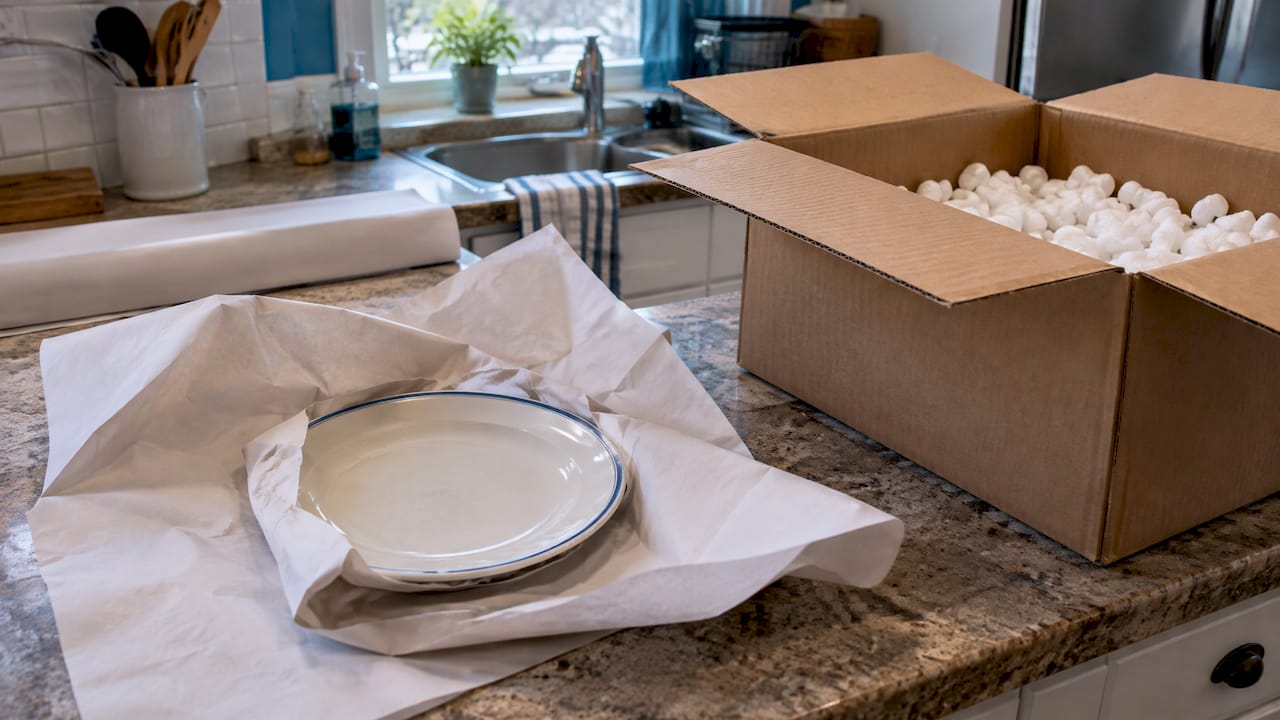
Packing peanuts are loose foam pieces. They fill empty space and stop things from sliding around. They do very little against a direct impact, and heavy items can sink through them and settle toward the bottom of the box. They are also messy to unpack, and some places restrict certain foam types, so for a kitchen move they are the weaker choice.
A published shipping test from Move.org shows why combining matters. The testers shipped four boxes of plates and bowls a 2,348-mile round trip, one cushioning material per box. Packing paper alone broke 6 of 12 items, foam peanuts alone broke 8 of 12 and bubble wrap alone broke 9 of 12. Their conclusion was that no one material is enough by itself and that combinations work better.
Translate that into a kitchen routine:
- Wrap each piece in packing paper. This is the contact layer.
- Add a second layer where the piece is fragile or thin, such as stemware or china. A bubble wrap sleeve over the paper works.
- Use crumpled paper as the filler to take up every gap. Paper conforms to odd shapes, doesn’t migrate and is quick to remove.
Peanuts belong in shipping boxes where a single item floats in a large void. In a dish pack that is packed correctly, there should be no void for them to fill.
How to pack a dish pack so it doesn’t rattle
A rattling box is a warning sign. Every sound is an item moving, and every movement is a chance to chip. Our walkthrough on packing a dish box without rattling goes deeper, and the step-by-step guide to packing dishes for moving covers the full kitchen. Here is the routine.
Before you start
Gather a stack of packing paper (far more than you expect), a roll of strong packing tape, a marker, and a few spare boxes. Clear a large flat surface. Wash and dry dishes first so you are not wrapping grit against glaze.
Step by step
- Build the base. Tape the bottom seam in both directions, an H pattern, so the floor holds up under weight. Add a few inches of crumpled paper as a cushion.
- Wrap plates in small stacks. Place a plate at the corner of a paper sheet, fold the corner over it, add another plate, and fold again. Wrap a short stack of plates together, then add another full sheet around the bundle.
- Stand plates on their edges. Plates are strongest at the rim. Packed on edge, the load travels around the rim. Packed flat, it presses through the face, and that is where plates crack. Position the bundles upright in the box, not stacked like a pile on a shelf.
- Put the heaviest items at the bottom. Plates and large bowls first, then lighter pieces such as cups, with glasses near the top.
- Wrap bowls and cups one by one. Nest similar bowls with a sheet between each. Wrap cups individually, and stuff a little crumpled paper inside any hollow.
- Handle stemware separately. Wrap each glass fully, stuff the bowl with paper, and stand it upright in a divider cell, or lay it carefully with padding all around. Never let two glasses touch.
- Add layers. After each layer, put a pad of crumpled paper before the next. Fill the sides too.
- Fill every gap. Press down on the top layer. If anything shifts, add more paper. The lid should close flat without bulging.
- Seal and label. Tape the top seam, mark it “Fragile” and “This Side Up,” and note the room. Keep it somewhere you can see it during loading so it goes in last-in, first-out position rather than at the bottom of a stack.
Where it goes wrong
- Too much weight. Stuffing the box to the brim with plates makes a box that is hard to carry and easy to drop. Stop when it is firm and still liftable.
- Too little paper. The most common mistake. If you can hear the box when you tilt it, add paper.
- Mixed loads. Putting a cast iron skillet on top of china is how breakage happens.
- A tired box. Don’t reuse dish packs that have been squashed or soaked. The board loses strength.
If you are packing in regular boxes, use the same method, choose the smallest box that holds the load, and add an extra layer of paper to the bottom and top.
Planning how many boxes you need
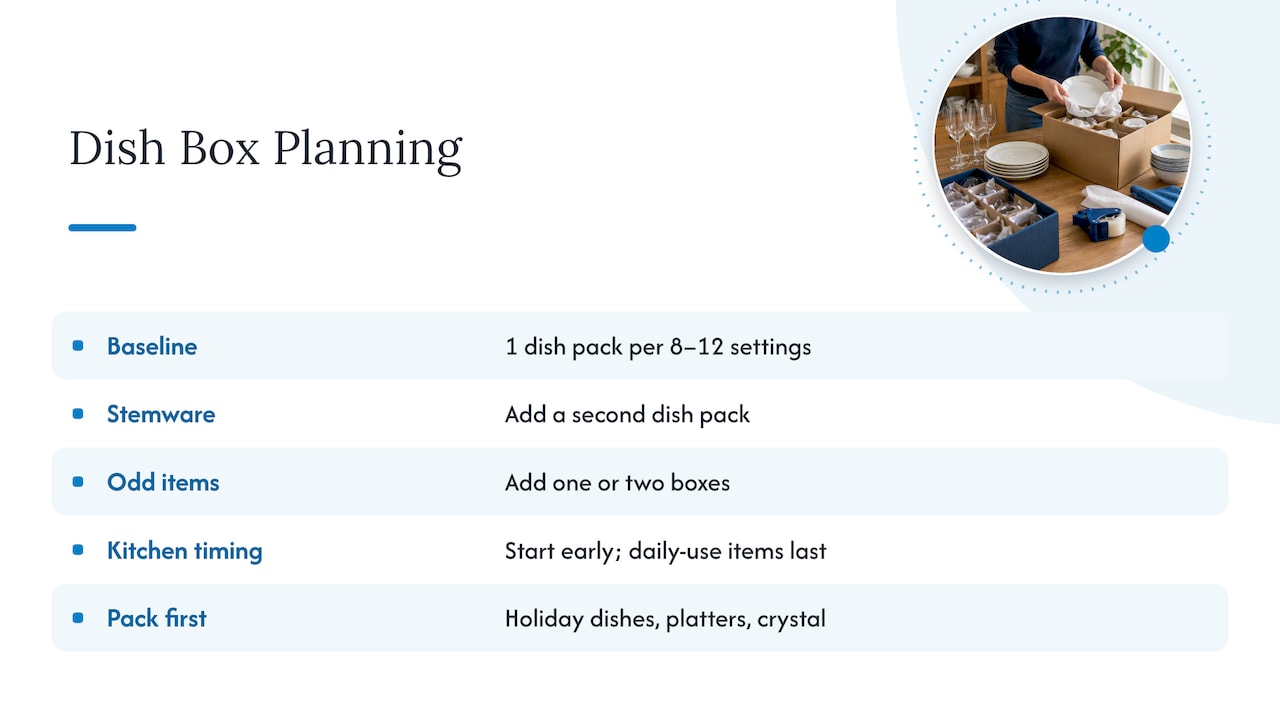
A rough planning figure used by box suppliers is one dish pack for every eight to twelve place settings, and a second for stemware. Dishes also vary: heavy stoneware takes more room per setting than thin porcelain, and a family that entertains owns more glasses than a student with a shared apartment.
Buy a few more than you think you need. It is much easier to return an unopened box than to find one at midnight. Add a box or two for odd items: platters, a punch bowl, a teapot. Platters often fit best when stood on edge along the side of a dish pack, wrapped like a plate.
Timing matters too. The kitchen takes longer than almost any other room. Start it early, but keep the plates and glasses you use daily for last. Pack the rarely used items first: the holiday dishes, the serving platters, the crystal.
Special situations: apartments, offices and storage
Students and small apartments. You may only own a few plates and a handful of mugs. A single dish pack, or one regular box with good paper wrap, covers it. Labeling matters more than the box type here: mark the box so it goes in the car, not under a pile of books.
Families. Larger households have the biggest kitchens and the most irreplaceable pieces. A set of dish packs plus divider cells for glasses is the sensible baseline. Pack the kitchen over several evenings rather than one rushed day.
Offices. Break rooms hold mugs, glassware and sometimes a coffee setup. A few dish packs usually handle it, and it is worth labeling by department so unpacking is quick when downtime must be minimal.
Storage. If boxes will sit for weeks, pick stronger board and stack them lower. Loaded cardboard can lose strength over time, especially in humid conditions, so keep heavy dish packs on the bottom and light boxes on top. Avoid placing them on bare floors where moisture collects.
When to let the movers pack it
Packing a kitchen is the part of a move most people underestimate. It takes hours, it needs a lot of paper, and one mistake costs you a plate. If the schedule is tight or the dishes matter to you, pack just the kitchen with professionals and handle the rest yourself.
When you hire us, you get a written estimate that accounts for size, access, distance and timing, so you know what packing adds before you commit.
Packing help from Affinity Moving
Affinity Moving is a licensed and insured moving company in Minneapolis and the Twin Cities. We offer packing and unpacking, packing materials, furniture disassembly and reassembly, and specialty handling for pianos, antiques and artwork, for homes, apartments, condos and offices. Our trained crews pack with the right box for each item, and we coordinate one plan from quote to move day so you know what happens when.
If you want the kitchen packed and moved by the same crew, see our packing services or ask for a written estimate through our local moving services page.

Moving a business instead? Our commercial office moving team plans around minimal downtime.
Our view on dish packs
We treat the dish pack as the one box you should not economize on. Everything else in a move can take a bump. Dishes can’t.
What we see as the main cause of broken kitchenware is simple: the wrong box, too little paper, or plates laid flat. All three are easy to avoid once you know them. Use a double-wall dish pack, wrap every piece, stand plates on edge, and fill the box until nothing moves.
Our approach to a move is the same as our approach to a box: plan it so nothing is left to chance. That is why we give written estimates that account for size, access, distance and timing, and why our trained crews handle your belongings with care from the first wrapped plate to the last unpacked one. If your kitchen is the part of the move you dread, hand it to us, and keep your attention on everything else.
Derrick
FAQ
Can I pack dishes in a regular box?
Yes, if you wrap each piece in paper, stand plates on their edges and fill every gap. A regular box is thinner and shorter than a dish pack, so it leaves less margin for error. For a full set of dishes or any glassware, a dish pack is the better choice.
Are packing peanuts or paper better for dishes?
Paper. Wrap each piece in packing paper and use crumpled paper as filler. Peanuts only fill space and do little against impact, so they are not suited to a dish pack. In the Move.org shipping test, no single material kept every dish intact, which is why layering matters.
How many dish packs do I need?
A common estimate is one dish pack per eight to twelve place settings, plus a second for stemware. Add a box for platters and odd pieces. It is better to have one spare than to run short on the last evening.
How heavy can a dish pack be?
Keep it light enough to lift comfortably. Movers recommend staying under 50 pounds per box, even when the carton itself could hold more. Dishes are dense, so stop filling before the box feels like a struggle.
Is it worth paying movers to pack the kitchen?
For many households, yes. The kitchen has the most fragile items and takes the longest. Our crews can pack and unpack it as part of your move, and the written estimate shows what that includes.