

Affinity Moving · October 19, 2026
← All articlesA hand truck is the upright, two-wheeled tool you tilt back to carry boxes, appliances and anything tall. A dolly, in its strict sense, is a flat four-wheeled platform you roll heavy, bulky items across on. Use a hand truck for stairs, tight turns and stacked boxes. Use a dolly for sofas, dressers and big loads on flat floors. Plenty of people use the words interchangeably, so the real question is which design your route and load need.
TL;DR
- Hand truck (two wheels): best for stairs, doorways, stacked boxes and upright appliances. You tilt it back and the wheels carry the weight.
- Furniture dolly (four wheels, flat): best for sofas, dressers, crates and several items at once on flat ground. Nothing to balance.
- Appliance dolly: a heavier hand truck with a strap and stair glides. It is the right pick for a fridge, washer or stove.
- Names overlap: in the US, “dolly” often just means hand truck. Ask for the design (two wheels or a four-wheeled platform), not the word.
- Stairs, heavy safes or pianos: this is where a trained crew earns its fee. A rented tool does not fix a bad route.
Table of Contents
- What each tool actually is
- Dolly vs. hand truck: side-by-side
- Which one for which job
- Using either tool without hurting yourself
- Renting or buying
- Perspective: where tools stop and crews start
- When to hand it to a crew
- FAQ
- Sources
What each tool actually is
The confusion is mostly about words. Wikipedia’s entry on the hand truck notes that in the US the terms hand truck and dolly are often used interchangeably, while British English usually says “sack truck” or “sack barrow” for the two-wheeled version. That is why a rental counter or a store listing can mean either thing when you say “dolly.”
Here is how we sort them on a job.
Hand truck (utility dolly)
An L-shaped frame with a small toe plate at the bottom, two large wheels and handles at the top. You slide the plate under the load, tilt the frame back toward you until the weight sits over the axle, then roll. Because the wheels carry the load and you only balance it, it handles stairs and curbs far better than anything flat.
Furniture dolly (platform dolly)
A low, flat platform, usually carpeted, on four swivel casters. You set the item on top (or tip it up and slide the dolly underneath) and push. There is no tilting and no balancing, so it feels stable. The trade-off: it cannot climb stairs, and a loaded platform will roll away on a slope.
Appliance dolly
This is a two-wheeled hand truck built for tall, heavy things. Torque Notes describes it as having a tall frame, a wide base and a built-in strap, and it often adds stair glides (the rails or belts that let it ride up and down steps). That strap is the key feature: it holds a refrigerator against the frame so it does not shift mid-flight.
The other “dolly”: a car dolly
If you searched “dolly” and landed on tow equipment, that is a different tool entirely. A tow dolly lifts the front or rear wheels of a vehicle off the road. Some states treat it separately from utility trailers: Virginia’s code is one example of exempting tow dollies from trailer registration in defined circumstances. Rules differ by state, so check yours. Everything below is about moving furniture, boxes and appliances by hand.
Dolly vs. hand truck: side-by-side
| Hand truck | Furniture dolly | Appliance dolly | |
|---|---|---|---|
| Wheels | 2 large wheels | 4 swivel casters | 2 wheels, often with stair glides |
| Shape | Upright L-frame | Flat platform | Tall frame with strap |
| Best loads | Boxes, small appliances, tall narrow items | Sofas, dressers, crates, several items | Fridges, washers, dryers, stoves |
| Stairs | Good | Poor, do not use | Best of the three |
| Flat, long hauls | Fine | Best | Fine |
| Typical capacity | 150 to 600 lbs | Varies by model | 600 to 1,200 lbs |
| Tilting needed | Yes | No | Yes |
The capacity ranges for hand trucks and appliance dollies come from Torque Notes. Always read the rating printed on the specific unit. For a rental example, one national home improvement retailer lists its rental appliance dolly at an 800 lb. loading capacity.
Which one for which job
Stairs and tight spaces: hand truck
Stairs are the hand truck’s home turf. The leverage that lets you tilt a load onto two wheels also lets you walk it up or down one step at a time. In a narrow hallway or a 30-inch door, a two-wheeled frame also takes up less room than a platform with an item on top.
Two habits matter on stairs. Keep the load on the uphill side of you when climbing and let the hand truck go first when descending, so it cannot fall on you. And bring a second person. Whoever stands below the load is the one who gets hurt if it slips.
Large furniture on flat floors: furniture dolly
A dresser, a sectional piece or a stack of bins on a four-wheeled platform is easier than any other method, as long as the floor is flat and the path is clear. If you are moving between a living room and a driveway with no steps, or loading a truck from a dock, a platform dolly saves your back. If there is even one step, plan something else.
One caution: protect the item. Set a moving blanket between the furniture and the platform edge, and strap it. Casters turn freely, so a sudden stop can slide the load off.
Boxes: usually a hand truck, with a weight limit
Stacked boxes are the textbook hand truck load. Stack heavy boxes on the bottom, keep the stack below your sightline, and do not stack higher than you can steer around corners. A dolly can also work for boxes on flat ground, but only if you strap them. Either way, the tool does not excuse an overloaded carton. Our guide to box weight limits movers recommend explains why we keep boxes under 50 pounds.
Appliances: appliance dolly or hand truck with a strap
If you are asking about an appliance dolly vs. a hand truck, the short answer is that the appliance version is the same idea, built stronger and with a strap and glides. A basic utility hand truck can move a microwave or a small freezer. A refrigerator, washer, dryer or range deserves the appliance model.
Whirlpool’s own appliance-moving guide describes the two tools this way: dollies are lifted off the ground and have four wheels, while hand trucks have two wheels, slide under the appliance and tilt back to balance it. Notice that manufacturers use the words differently from retail listings. This is exactly why you should check the photo and the wheel count before you rent.
Two appliance-specific rules from the manufacturer:
- Do not tilt a fridge forward onto the dolly. Whirlpool’s moving instructions say to tilt it slightly to the side to slide the equipment underneath.
- If the fridge has to travel on its side, let it stand upright afterward. The same page gives a waiting period, typically 8 to 24 hours, before plugging it back in so the sealed system can settle. Check your model’s manual for the exact figure.
Whirlpool also says a refrigerator should never be moved alone: you need another person, a dolly and straps. For the full routine, including defrosting and disposal, see our guide to moving or disposing of a refrigerator in Minnesota. Washers and dryers have their own steps (transit bolts, hoses, drum locks), covered in how to move a washer and dryer safely.
One more practice to skip: “walking” an appliance by rocking it side to side. Whirlpool’s guidance warns that it risks floor damage and injury, and recommends proper equipment such as sliders and a dolly instead.
Mattresses, safes and pianos
Mattresses are light but awkward. A hand truck is a poor fit, and a flat dolly only helps on level ground. When stairs are involved, our piece on when hiring pros for a mattress is worth it lays out the decision.
A gun safe can weigh far more than a hand truck rating, so it needs a purpose-rated approach. We say more in moving a gun safe: DIY on level floors, pros for stairs. Pianos are different again: an upright is tall, top-heavy and delicate, and a standard hand truck is not the answer.
Using either tool without hurting yourself
Most moving injuries come from technique, not from the equipment. OSHA’s materials-handling guidance is aimed at electrical contractors, but the ergonomics apply to any dolly or hand truck at home:
- Push, don’t pull. Pushing uses your body weight and is less straining than pulling.
- Keep handles in your power zone, roughly between your waist and mid-chest.
- Walk the route first. Look for thresholds, curbs, rugs and tight corners before you load anything.
Our own additions, from moving crews’ daily habits:
- Measure the item and the narrowest doorway before you start.
- Remove doors from their hinges or take off a sofa’s legs if that buys clearance.
- Strap every load, even for a short trip.
- Put one person at the load and one at the path, calling out steps and corners.
- Stop if the load feels unstable. A rebalanced load costs you a minute. A dropped one costs far more.
If you are not very strong or are smaller in stature, the tool choice matters more, not less. A good appliance dolly with glides does more of the lifting than a basic frame, and a platform dolly removes balancing entirely on flat ground.
Renting or buying
For a single move, renting usually makes more sense than buying, and most big-box stores and truck rental counters carry both types. According to one guide to renting a dolly in the US, as of December 2025 daily rates ran about $7 to $12 for a standard hand truck or furniture dolly and $12 to $20 for an appliance dolly. Many providers also offer 4-hour, daily and weekly rates, and the same guide says a week often costs only two to three times the daily rate. Prices and deposits vary by store, so confirm locally.
Before you reserve:
- Ask for the exact type (two wheels or four, strap, stair glides).
- Check the rated capacity against the heaviest item.
- Ask whether you need to leave a deposit and what the return window is.
- Reserve for the hours that include loading and unloading, not just driving.
Buying makes sense if you move often, have a basement full of boxes, or run a small business that gets regular deliveries. In that case, a folding hand truck stores easily and a four-wheeled platform doubles as a garage mover.
Perspective: where tools stop and crews start
We move people around the Twin Cities, so we see the same mistakes every week. The most common is picking the tool before looking at the route. People rent a four-wheeled dolly for a third-floor walkup, or a basic hand truck for a full-size fridge, and then discover the problem on the stairs. The second most common is trusting the tool to carry a load it was never rated for.
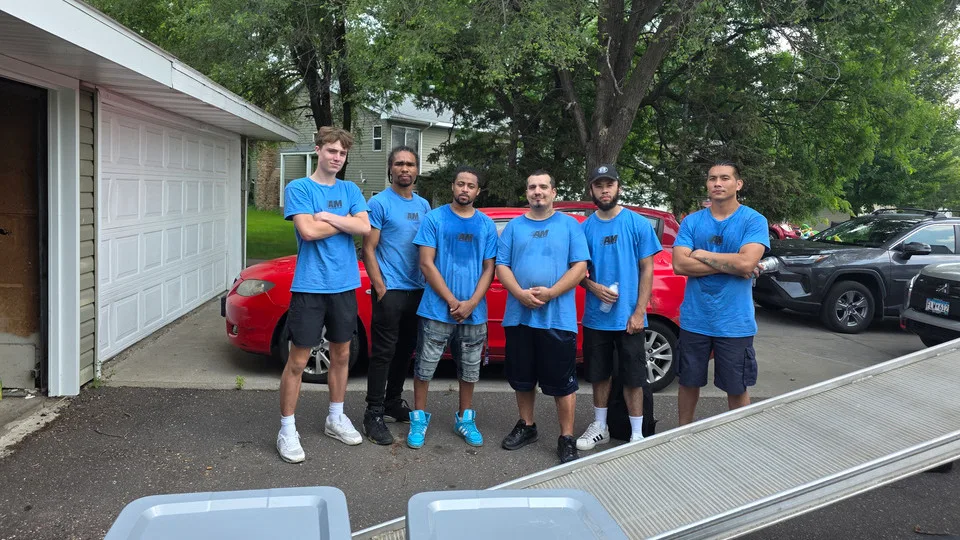
Our rule: walk the path first, then choose. Flat and short, a platform dolly. Stairs, a two-wheeled frame with a strap and glides. A long carry with turns, or anything awkward, we plan a second set of hands and often a different method altogether, such as sliders or a stair-climbing technique our crews have practiced. We also tell customers plainly when a job is simple enough to do themselves. A couple of boxes and a small bookcase do not need a crew.
What we do care about is that you know the plan before moving day: who carries what, which route, what equipment. That is the same reason we write estimates around size, access, distance and timing. Access (stairs, elevators, long carries) is a cost driver for a reason.
— Derrick
When to hand it to a crew
A rented dolly is a good answer for a short, flat, well-planned move. It is a poor answer when any of these apply:
- A full-size fridge, a piano or a safe has to go down a flight or more of stairs.
- You are moving a whole apartment and carrying every box one at a time.
- A move has a hard deadline, like a lease end or a closing date.
- Anyone helping has back, knee or heart concerns.
- You need furniture taken apart and reassembled.
Affinity Moving is a licensed and insured company based in Minneapolis. Our trained crews bring their own equipment and handle local moves, apartment moves, packing, labor-only help, furniture disassembly and reassembly, and piano moving, plus specialty items like antiques and artwork. If you just need muscle at the loading end, labor-only service may be all you need. Tell us about your stairs and your heaviest items and we will write you a detailed estimate in advance. Request a free estimate and we will plan it with you.
Tight on space? Our tips for moving furniture into a small apartment cover doorways, turns and what to disassemble first.
FAQ
Is a dolly the same as a hand truck?
In everyday American speech, often yes. People say “dolly” for both. Strictly, a hand truck has two wheels and an upright frame, while a dolly is a flat platform on four wheels. When you rent or buy, describe the wheel count and shape so you get the tool you need.
What is the difference between an appliance dolly and a hand truck?
An appliance dolly is a heavy-duty hand truck with a taller frame, a strap and usually stair glides. According to Torque Notes, appliance dollies typically carry 600 to 1,200 lbs, against 150 to 600 lbs for basic hand trucks. Use the appliance model for refrigerators, washers and ranges.
Can I use a furniture dolly on stairs?
No. A four-wheeled platform has nothing to hold it on a step, and it can roll as soon as it tips. Use a two-wheeled hand truck or appliance dolly with a strap, or hire a crew for heavy items on stairs.
Which is better for moving boxes?
A hand truck is usually better, especially if you have steps or cars to load. A platform dolly can work on flat ground if you strap the stack. Keep each box at a manageable weight, since the tool only helps with the carry, not the lift.
How much does it cost to rent a dolly or hand truck?
One December 2025 rental guide puts daily rates at $7 to $12 for standard units and $12 to $20 for appliance dollies. Your local store may differ, so check its current price and deposit.
Sources
- Hand truck, Wikipedia
- Virginia Code § 46.2-1119
- Appliance Dolly Rental, The Home Depot
- How to Move Heavy Appliances, Whirlpool
- Preparing for Vacation or Moving, Whirlpool Product Help
- How To Move A Refrigerator, Whirlpool
- Pushing, Pulling and Carrying, OSHA
- How to Rent a Dolly in the US