

Affinity Moving · November 22, 2026
? All articlesAn elevator move fee is a charge your building makes for letting you use its elevator (or freight elevator and loading dock) on moving day. Across the U.S. it is usually a one-time fee of a few hundred dollars, often paired with a refundable deposit, and it is set by the building, not by your movers. The surprise rarely comes from the amount. It comes from the rules around it: how far ahead you must book, which hours are allowed, and what insurance paperwork the building wants. A written estimate that already accounts for your building’s access, which is how we quote at Affinity Moving, keeps those details from turning into extra cost on the day.
TL;DR
- Typical elevator move fees run from about $50 to $500, and many buildings add a refundable deposit of $200 to $1,000.
- The fee goes to the building or HOA, not to your landlord or your movers, and it is usually non-refundable. The deposit comes back after an inspection if nothing is damaged.
- Most buildings want one to two weeks’ notice, fixed time windows, weekday hours and a certificate of insurance from your movers.
- Fines for moving without a reservation or outside approved hours can be $100 to $200 or more.
- Ask the building office for the written move policy before you book movers, then hand it to them so the estimate matches the rules.
Table of Contents
- What an elevator move fee actually is
- What buildings charge: real examples
- What pushes the cost up or down
- Who pays, and when
- What the building will ask for besides money
- A worked example
- Can you reduce or dispute the fee?
- Tell your movers about the elevator before you get a quote
- Moving with Affinity
- Our perspective
- FAQ
- Sources
What an elevator move fee actually is
Buildings with shared elevators, hallways and entrances face real wear when dozens of boxes and a sofa pass through. So they charge for moves. The charge can take several forms:
- A move-in or move-out fee. A flat, usually non-refundable charge that covers staff time, scheduling and wear on common areas.
- An elevator reservation or padding fee. A smaller charge for blocking the elevator off for you and, in some buildings, hanging protective pads.
- A damage deposit. Money you hand over in advance and get back if the inspection after the move finds no damage.
- An after-hours surcharge or a fine. Applied if you move outside permitted times or without reserving.
In a condo or HOA community, the association can charge such a fee only if its governing documents or a properly adopted board rule create one, according to OurHOA’s guide to move-in and move-out fees. That guide also notes that the charges may be refundable deposits or administrative fees meant to offset costs such as reserving and padding an elevator, staff time and extra cleaning. In a rental building the rule usually sits in your lease or a building rider.
What buildings charge: real examples
The national picture is a wide range, so the most useful numbers are published building policies. These are real documents from associations across the country.
| Building | Non-refundable fee | Refundable deposit | Other terms |
|---|---|---|---|
| River Place North, Arlington, VA (2026) | $50 | $200 | Book 2 days ahead, 3-hour maximum, $200 fine for unreserved moves |
| Rivo at Ringling, Sarasota, FL | $100 | $1,000 | Mon–Fri 8 AM–4 PM, $150 fine for violations |
| Casa Costa, Boynton Beach, FL | $100 | $500 | Book a week ahead, up to 4 hours, insurance certificate required |
| Cityplace South Tower, Chicago | $150 | $1,000 | Book 7 days ahead, 3½-hour blocks, Mon–Fri only |
| West Ocean HOA, Long Beach, CA (policy dated 2015) | $250 | $500 | 5-hour window, $25 per extra hour, Mon–Fri only |
| Hinman House, Chicago area | $300 (unfurnished move) | $200 | $150 for furnished moves of luggage and up to six boxes |
A few patterns stand out. Fees are small compared with deposits in most large buildings. Deposits of $500 to $1,000 are common, and that is cash you front before moving day. And the fee is rarely the only requirement.
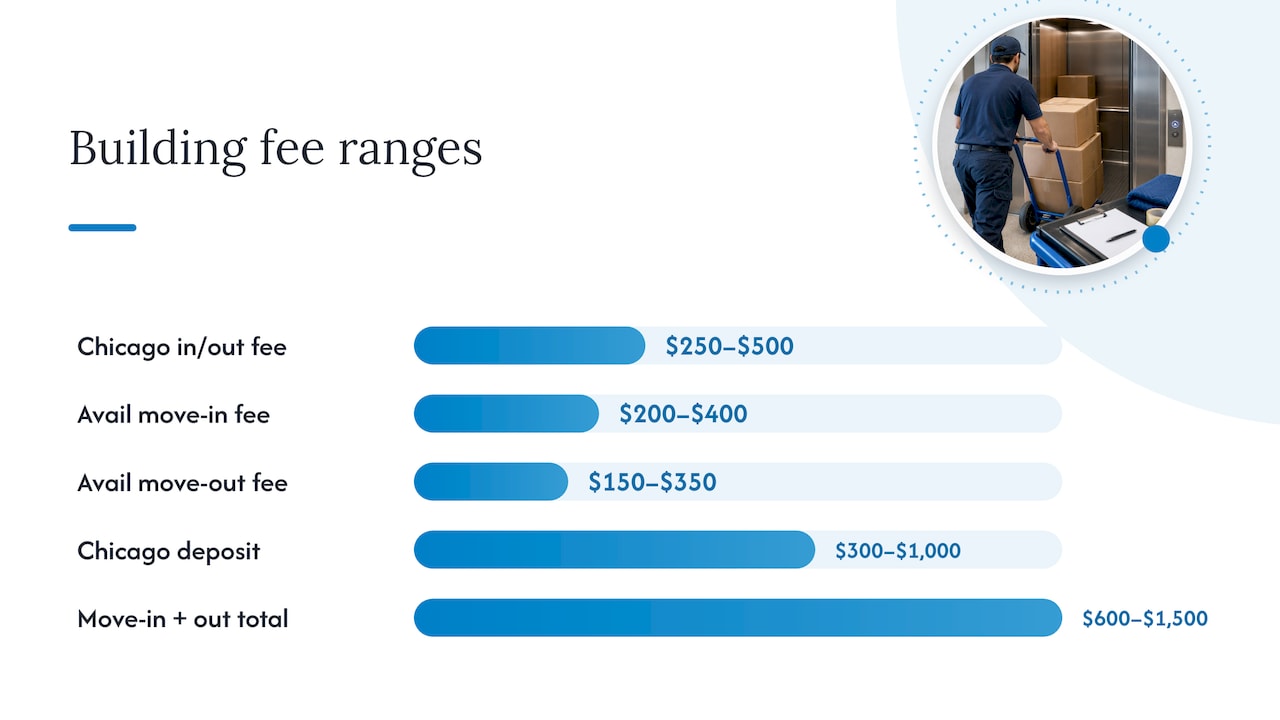
Broader guides give similar ranges. A Chicago building-fee guide from 2026 puts elevator-building move-in and move-out fees at $250 to $500 each, refundable deposits at $300 to $1,000, and a total potential cost of $600 to $1,500 for a move in and out. An Avail article on apartment fees lists move-in fees of roughly $200 to $400 and move-out fees of roughly $150 to $350 depending on the building. Treat these as ranges to sanity-check a quote, not as a price for your building. Your own building’s policy is the only number that counts.
What pushes the cost up or down
Several things explain why two buildings in the same city can charge very differently:
- Building type and size. High-rises with staffed freight elevators and loading docks tend to charge more than a three-story walk-up with a single small elevator.
- Move-in versus move-out. Some buildings charge only on the way in. Others charge both. Condo sellers frequently pay the move-out fee, while buyers pay move-in charges and deposits, according to the same Chicago fee guide.
- Timing. After-hours slots and weekends can carry surcharges. Peak moving season, May through September, means fewer open slots.
- How long you hold the elevator. Some buildings sell a fixed block, others bill extra by the hour. West Ocean HOA’s policy, for example, adds $25 for each hour past the reserved window.
- Furnished or unfurnished. Hinman House charges half as much for a light furnished move as for a full unfurnished one.
Who pays, and when
The fee usually goes to the building management or association, not to your landlord. Renters almost always pay move-in fees and may pay move-out fees depending on the lease. Condo owners are responsible for their association’s charges even when a tenant is the one moving. Hinman House, for instance, states that the unit owner or landlord is ultimately responsible for scheduling and paying the fees even for rental tenants.
Timing matters too. Fees and deposits are typically due when you reserve, not on moving day. Cityplace South Tower asks for the fee and the deposit at the time of reservation, and Casa Costa wants its fee and deposit at least a week before the move. Budget for the cash earlier than you expect.
Refundable or not?
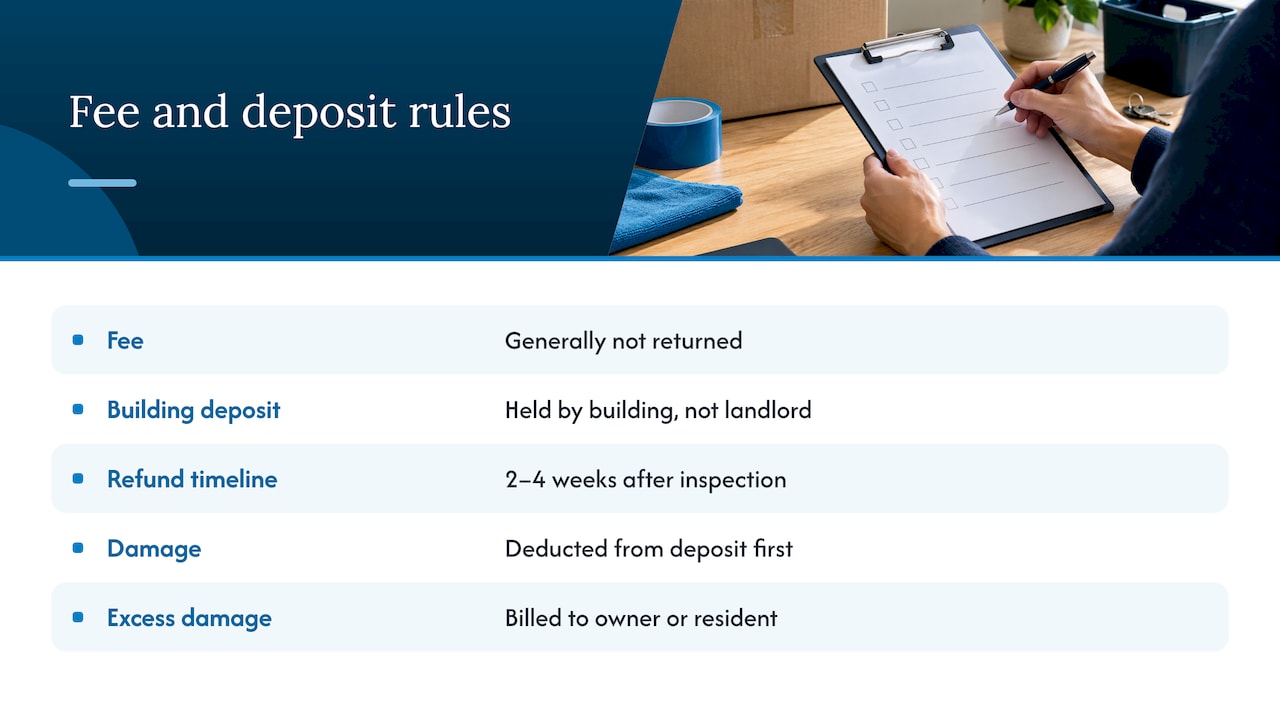
The fee is generally gone once you pay it. The deposit is the part that returns. In the Chicago guide above, deposit refunds take two to four weeks after inspection. If damage happens, it comes out of the deposit first. Several associations state that any damage beyond the deposit is billed to the owner or resident, so a careless moving day costs more than the deposit.
If you are a renter, also keep your regular lease deposit separate in your mind. An elevator deposit is held by the building, not the landlord, and has its own refund timeline.
What the building will ask for besides money
The fee is the visible part. The booking rules are where moves go wrong. Published policies repeatedly ask for the same things:
- Advance notice. Two days at River Place North, seven days at Cityplace South Tower and West Ocean, a week at Casa Costa. Plan on one to two weeks, and longer for big-city high-rises during summer.
- Fixed hours. Weekday daytime windows are standard. Rivo at Ringling allows Monday to Friday, 8 AM to 4 PM. Hinman House allows Saturday mornings but never Sundays.
- One move at a time. Many buildings allow one move per unit or per day, so a missed slot can push you back days.
- A certificate of insurance (COI). This is a document from the moving company’s insurer proving coverage. Cityplace South Tower requires at least $1,000,000 in general liability, plus workers’ compensation and auto liability, with the association named as additional insured. Fortune House in Miami asks for the same $1,000,000 general liability and workers’ comp certificates.
- Pads and protection. Some buildings install carpet or wall protectors themselves. Others require hard-surface hallway protection from the movers.
- Inspections. The Empire HOA in Houston runs pre- and post-move inspections tied to its $1,000 deposit.
The insurance requirement is why hiring licensed and insured movers matters in a managed building. Buildings that require a COI before they will confirm your slot cannot confirm it if your helpers are friends with a rented van. We are a licensed and insured Minneapolis moving company, which is the baseline most building offices expect.
A worked example
Say you are renting a one-bedroom in a mid-rise with a reservable freight elevator. The building office gives you this policy:
- Non-refundable move-in fee: $150
- Refundable deposit: $500
- Four-hour window, Monday to Friday, 9 AM to 4 PM
- Seven days’ notice, COI required
Your upfront cash is $650, of which $500 comes back if the move-out inspection is clean. If your movers arrive late and the move runs past the window, you may face an overtime charge or a fine, and the movers’ hourly clock is running while the elevator is out of reach. So the real saving is not a lower fee. It is booking a slot that fits the size of the move, with a crew that arrives on time and is ready to load.
Can you reduce or dispute the fee?
Mostly you cannot negotiate it. The Chicago guide notes that fees set by building management or HOA boards are enforced uniformly and rarely negotiable. What you can control is the number of charges you trigger:
- Move on weekdays. Avoid weekend and after-hours surcharges.
- Avoid peak season if your lease or closing date has any flexibility. May through September is the crowded stretch.
- Book early. Late or missed slots invite cancellation fees and fines.
- Keep the move inside the window. Pack and label before the crew arrives so loading starts the minute the elevator is yours.
If a charge looks wrong, ask for the policy in writing and check where it comes from. For condo owners, the association needs authority in its governing documents or a valid board rule. Rules differ by state: OurHOA notes that California limits an association’s document-transfer fee to its actual cost, while Florida caps certain transfer or screening fees at $150 per applicant. Some local rental ordinances go further. Evanston, Illinois, for example, defines a move-in fee as one reasonably related to the housing provider’s costs and bars fees above reasonable costs. If you think a fee is out of line, ask your state or local housing office or an attorney about the rules where you live.
Tell your movers about the elevator before you get a quote
Access is one of the main things that changes a moving estimate. Our written estimates take into account size, access, distance and timing, so an elevator with a four-hour window, a long hallway or a loading dock is part of the plan from the start. Give your mover these details up front:
- The building’s written move policy, including permitted hours and window length
- Whether the elevator is reserved, and for which date and time
- Where the truck can park and how far it is from the loading dock
- Any insurance wording the building requires
- Floor and unit number, and whether there is a service elevator
With those in hand, there are no surprises about what the move involves, which is the point of a written estimate. That matters most for students moving out on the same weekend as everyone else, and for offices that need to be back to work Monday morning.
Moving with Affinity
Whether you are moving a studio or a floor of an office, our crews handle apartment moves and residential moves across Minneapolis and the Twin Cities. For offices, our commercial moving services are built around keeping downtime short. We also offer packing and unpacking, furniture disassembly and reassembly, and specialty handling for items like pianos. Furniture that is already boxed and broken down moves through a reserved elevator faster.
To get a written estimate based on your building’s access and timing, request a free estimate.

Our perspective
Most people think of the elevator fee as a cost of moving, and it is. But in our experience the number on the building’s form matters less than what the form says about timing. A reserved window is a promise to the building that you will be done by a set hour, and everything about the day should be built around keeping that promise.
That is why we prefer to know the details well in advance. When we write an estimate, we want the size of the move, the access, the distance and the timing on the page before anyone lifts a box. A clear plan from quote to move day is what lets a trained, licensed and insured crew work carefully and efficiently instead of improvising in a hallway.
So our advice is simple. Get the building’s policy in writing early, book the elevator as soon as you have a date, and give us the policy so the plan fits the rules. Your move then runs on a schedule instead of on luck.
Derrick
FAQ
How much is a typical elevator move fee?
Published building policies range from about $50 to $500 for the non-refundable fee. Large buildings often add a refundable deposit of $500 to $1,000. Your building’s written policy sets the real figure.
Do I get the elevator fee back?
Usually not. The fee covers scheduling, staff time and wear on common areas. The separate damage deposit is refundable, typically two to four weeks after an inspection finds no damage, according to a 2026 Chicago fee guide.
Who pays the elevator fee, the tenant or the landlord?
In most rental buildings the tenant pays move-in fees, and the fee goes to the building management. In a condo, the unit owner is responsible to the association, even if a tenant is the one moving, as Hinman House’s FAQ states.
How far ahead do I need to reserve the elevator?
Anywhere from 48 hours to several weeks. The published policies above ask for two days, one week or seven days, and big-city high-rises can ask for more. Reserve as soon as your move date is set.
Why does my building want a certificate of insurance from my movers?
The certificate proves the moving company carries liability and workers’ compensation coverage and names the association as an additional insured, so damage to the building is covered. Cityplace South Tower and Fortune House both require one.
Sources
- Can an HOA charge a move-in or move-out fee? (OurHOA)
- Freight Elevator & Loading Dock Reservation Guidelines (River Place North)
- Move-in/move-out procedures (Rivo at Ringling)
- Settling In (Casa Costa)
- Cityplace South Tower Condominium Association policy
- Moving Protocols (West Ocean HOA)
- Hinman House Condominium Association FAQ
- Elevator Building Fees in Chicago
- The Most Common Fees to Expect When Renting an Apartment (Avail)
- Elevator Reservation Form (Fortune House)
- Move In/Out Acknowledgment and Elevator Reservation (The Empire HOA)
- Evanston Code of Ordinances, Housing Provider and Tenant Regulations