

Affinity Moving · November 23, 2026
? All articlesA conference table is one of the hardest things in an office to move. It is long, heavy, awkward to grip and often finished in veneer that cracks if the top flexes. The safe way to move one is to measure the route first, take the table apart where the manufacturer allows it, pad every edge, and let a trained crew do the lifting. At Affinity Moving, our Minneapolis crews handle furniture disassembly and reassembly as part of commercial moves, so the table arrives in the new room assembled and ready to use.
This guide walks through the whole job in order: planning the route, disassembly, protection, getting through doors, loading and setting the table up again.
TL;DR
- Walk the full route and measure every door, turn and elevator before move day. A table that fits in the room may not fit through the door.
- Take off only what is bolted on (legs, bases, leaves). Leave glued joints alone, and bag and label every screw.
- Never carry a long top by its ends or drag it. Use padded dollies and enough people.
- Reassemble on a clean, padded surface, then flip the table upright with several people holding the frame, not the top.
- A large boardroom table is a crew job. Ask us for a written estimate that covers access, disassembly and reassembly.
Table of Contents
- Start with the route, not the table
- Why the lifting limit matters here
- Disassemble the table step by step
- Protect the top and the finish
- Get it through doors, halls and elevators
- Load and secure it for the truck
- Unload and reassemble
- When a crew is the better choice
- Moving your conference table with Affinity Moving
- Our view: the table is a logistics problem
- FAQ
- Sources
Start with the route, not the table
Most conference table accidents happen at a doorway or a corner, not at the table itself. Before anyone touches it, walk the path from the room it sits in to the truck, and from the truck to the new room. Look at every doorway, corridor turn, elevator, stairwell and threshold.
Measure door frames at their narrowest point. One office-furniture guide notes that a nominal 35-inch commercial door can give you only about 31 inches of real clearance once hinges and strike plates are counted. Write down elevator width, depth and diagonal. Mark the tight spots on a simple sketch so everyone on the move knows where to slow down.
Then check what the building requires. The same guide notes that some commercial buildings want around 48 hours’ notice for large furniture deliveries, along with loading dock reservations, freight elevator access, security procedures and proof of insurance. Property managers in Minneapolis office buildings commonly ask for a certificate of insurance before a mover can use the freight elevator, so ask early. Our crews are licensed and insured, which is exactly the paperwork a building manager asks to see.
Know what size and type of table you have
Size decides the method. FindOfficeFurniture’s guidance says tables under 96 inches can usually be tilted onto their side and slid onto padded dollies. Tables longer than that should be split into sections if they are modular, or at least have the base removed from the top. The same source puts a standard commercial door at 36 inches wide.
The arithmetic is simple. A table that is 48 inches deep will not go through a 36-inch door flat. Turned on its side, the height becomes the width, and it fits. If the table is longer than the hallway turn allows, no amount of tilting will fix it, and the table has to come apart.
Identify which of these you have:
- Single-piece top on a pedestal or leg base. Remove the base, move the top on its edge.
- Modular sections. Disconnect the sections and move each one separately.
- Table with integrated power and data. Disconnect and secure the cables before anything else.
- Stone, glass or very heavy solid-wood top. These need special handling. Our glass tabletop checklist covers the glass case in detail.
Why the lifting limit matters here
A lot of people assume two strong adults can carry any table. The numbers say otherwise. The 1991 Revised NIOSH Lifting Equation, explained in a North Carolina Department of Labor materials-handling guide, starts from a 51-pound load that nearly all healthy workers can lift once under ideal conditions. Six factors then reduce that limit: horizontal distance, vertical distance, how far you carry, how often you lift, twisting and how well you can grip. A Lifting Index above 1.0 signals higher low-back-pain risk.
A conference table is the opposite of ideal: wide, slippery, awkward and often carried through turns. One furniture retailer’s guidance says tables of 120 inches or longer, or over 200 pounds, should be moved by two to four people using padded furniture dollies, and never dragged across the floor. This is the main reason a trained crew with the right equipment makes sense for anything beyond a small table.
Disassemble the table step by step
Always check the manufacturer’s instructions first. Many office tables publish them, and they show which fasteners are meant to come out. Two examples show what the process looks like.
Kimball International’s 2025 table disassembly instructions have you turn the table upside down on a stable surface, then remove the hardware securing legs, bases, aprons, facade rails and cleats. Casters or glides come off next, and any internal weighting is removed if the table has it. The guide lists safety glasses, screwdrivers, Allen wrenches, pliers, a mallet and gloves, and puts the work at 20 to 30 minutes.
Nucraft’s Saber conference table guide calls for a Phillips screwdriver and a 1/4-inch hex driver, and also allows about 30 minutes. It identifies the parts you will meet inside: a veneer-faced MDF top, a base panel, an aluminum support beam, steel L-brackets and plastic glides with threaded inserts.
Here is the routine that follows from those instructions.
- Clear the room and the path. Remove chairs, credenza items and anything on the table. Lay heavy-duty cardboard or floor-protection board along the route.
- Photograph the table from several angles, including the underside, before you loosen anything.
- Disconnect cables. Many conference tables have power and data ports. If the room’s wiring needs to change in the new space, plan adding office data cabling ahead of move day so the table is not waiting on a connection.
- Lay the table upside down on a padded, stable surface, such as moving blankets over clean floor.
- Remove bolted parts only. Take off legs, bases, leaves and extensions. Amish Furniture Factory’s guidance points out that a mortise-and-tenon joint on a solid wood table is a glued structural joint, not a fastener, so leave shop-glued joints alone.
- Bag and label hardware. Put screws from each leg or section in its own bag, label it with its location, and tape the bag to the part it belongs to, on an unfinished face. It is the small bags that go missing, and a missing bolt can stall an office set-up.
This is the step where we take the most work off your hands. Furniture disassembly and reassembly is part of our service, so you do not have to hunt for the right driver or find out halfway through that a joint was never meant to come apart.
Protect the top and the finish
The top is the expensive part, and it is the part most easily damaged. Veneer chips at the corners, finishes mark, and a long unsupported span can crack.
- Use moving blankets, not tape on the surface. Amish Furniture Factory warns never to run tape across a finished surface. Adhesive left on a lacquer or oil finish for a week in a hot truck can lift the finish.
- Pad the corners and edges and wrap the blankets with stretch wrap that touches only the blankets.
- Keep the top supported. Never carry a long top flat by its ends. An unsupported span can flex and crack veneer or snap a seam, so carry it on edge or support it along its length.
- Protect the floors on both ends. Lay board along the route. Rolling straight across thresholds, rather than at an angle, keeps wheels from catching.
For a closer look at what professionals do with blankets, pads and wrap, see our guide to furniture protection by movers. If your table is stone, an antique or an artisan piece, the same careful approach applies, and our antique furniture packing steps explain it.
Get it through doors, halls and elevators
This is where your earlier measurements pay off.
- Tilt, do not force. Turn the top on its long edge, with the bottom edge on a padded dolly, so one person steers and the others support.
- Leave the base for last. Move the heavy base separately. A top and base moved together are far harder to control.
- Move at a walking pace. Stop at every turn and call out the clearance before you pivot.
- Assign one person to spot. That person watches the clearance at the top, door frames and light fixtures, and keeps the route clear of people.
- Do not drag. Dragging scratches floors and strips glides and finishes.
If the elevator is too small for the top on edge, the stairwell may be the only option, and that is where a crew with the right numbers matters most. Stairs multiply every risk in the lifting equation above. Our guide on moving a sectional sofa shows the same turn-and-pivot thinking applied to another awkward piece, and the principle holds for a table top.
Load and secure it for the truck
A table top should travel on its edge, never flat with other items stacked on it. Place it against the truck wall on padding, with the base parts and labeled hardware bags kept together nearby. Strap it so it cannot shift, but keep straps over blankets, not bare wood.
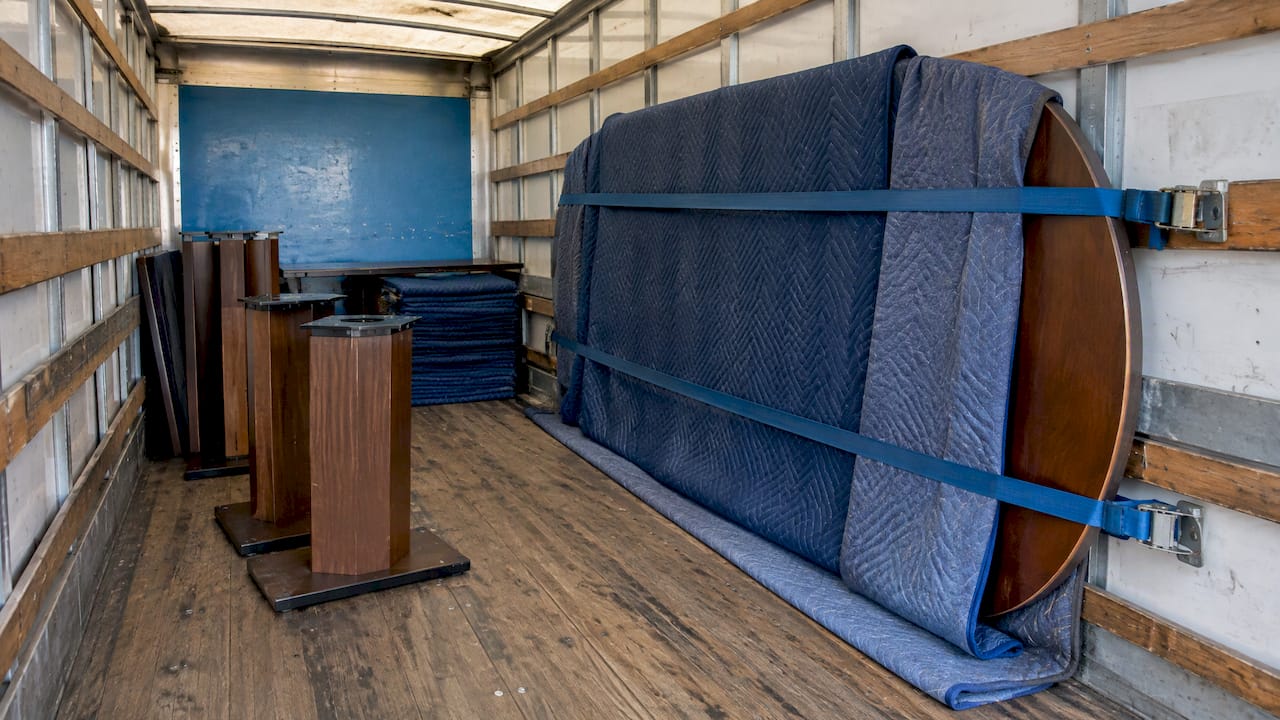
Some furniture makers set their own standards for heavy pieces. Crate & Barrel’s vendor packaging guidelines require pieces over 150 pounds to sit on wood pallets secured with plastic strapping, and stone, travertine and marble table tops to be packed in a wooden crate. The point carries over: heavy and stone-topped tables need purpose-built support, not just a blanket. We supply packing materials, and our packing services cover what a table needs for the trip.
Unload and reassemble
Reassembly is the reverse of disassembly, with one extra caution: the final flip.
Uplift Desk’s conference table instructions say to assemble on a clean carpet or blanket and check all parts against the contents list before discarding packaging. They then call for three to four people to flip the assembled table upright while holding the frame side brackets, never lifting by the tabletop alone. Roll the table into place on unlocked casters, or have two people lift it if it has none. Do not drag it.
A good order of work at the destination:
- Place the top face-down on blankets in or near the final room.
- Attach legs or base with the labeled hardware, using the same tools you used to take it apart.
- Tighten fasteners evenly, then check that the table sits level.
- Flip it upright with enough people, holding the frame.
- Reconnect power and data, and fit glides or casters.
- Check the surface for marks before the chairs go back.
When a crew is the better choice
A small, light table with a few bolts is a manageable job. Everything else leans toward professionals: a table of 120 inches or more, a stone or glass top, tight elevators, stairs, a building that requires insurance paperwork, or an office that cannot afford a day of downtime. In those cases the table is rarely the only thing moving, and the conference room is one part of a larger schedule.
Students and renters moving a smaller table into an apartment face a different problem: tight landings and narrow doors. Our guide to moving furniture into a small apartment covers that case. If the table is the only thing you need moved, our small move service is built for partial loads.
Moving your conference table with Affinity Moving
We are a licensed and insured Minneapolis moving company handling local and long-distance moves for homes, apartments and businesses. For offices, we plan the move from the quote to move day as one plan, with a detailed written estimate that takes into account size, access, distance and timing. That means the table, the stairs, the elevator booking and the reassembly are all described before anyone arrives.
Our trained crews handle furniture disassembly and reassembly, packing and unpacking, specialty items and packing materials. You can see the full range on our services page, or start with Commercial Moving Services if the table is part of an office relocation.

Tell us the table’s size, the floors involved and the building’s access rules, and we will write the estimate around them. You can request a free estimate here.
Our view: the table is a logistics problem
People treat a conference table as a furniture problem. In our experience it is a logistics problem. The table is rarely too heavy for a crew. What goes wrong is a door that is three inches too narrow, a freight elevator nobody booked, or a bag of bolts that stayed behind.
That is why we write our estimates around the details: size, access, distance and timing. When those are on paper before move day, nobody is improvising in a hallway with a 10-foot top on its edge.
We would rather our crews handle disassembly and reassembly as part of one plan than hand an office a pile of parts and a bag of screws. The goal is simple: you walk into the new conference room and the table is already there, level and unmarked.
Derrick
FAQ
Can I move a conference table without taking it apart?
Sometimes. Tables under about 96 inches can usually be tilted onto their side and moved on padded dollies, as long as the doors and turns allow it. Longer tables should be split into sections if modular, or have the base removed from the top. Measure the narrowest door first, because the effective clearance is often smaller than the stated width.
How many people does it take to move a conference table?
For tables 120 inches or longer, or over 200 pounds, guidance from an office-furniture seller calls for two to four people with padded dollies. Even a smaller table calls for help, since one person can safely lift far less than a table weighs. A trained crew brings the right headcount and equipment to the job.
How do I keep the top from cracking or scratching?
Keep it supported along its length, never carry it flat by the ends, and wrap it in moving blankets rather than putting tape on the finish. Lay floor protection along the route and never drag the table. Our crews use pads and wrap as part of every move, and our packing materials cover the rest.
What should I do with the screws and hardware?
Bag the hardware from each leg, base or section separately, label every bag with its location and tape it to the part it belongs to. Photograph the table before you start. This makes reassembly fast and avoids guessing which bolt goes where.
Does the building need to know I am moving a large table?
In many commercial buildings, yes. Some require around 48 hours’ notice for large items, plus freight elevator reservations, security procedures and proof of insurance. Ask your property manager early, and share the details with us so they go into the written estimate.
Sources
- Conference Room Table Setup: Pre-Delivery Checklist
- How do I transport and relocate a large conference table?
- How do I move a large conference table?
- A guide to manual materials handling and back safety, N.C. Department of Labor
- Kimball International: Tables disassembly instructions, 2025
- Nucraft Saber disassembly and service part guide
- Prevent Furniture Damage During a Move
- Crate & Barrel Furniture Packaging Guidelines, 2020
- Uplift Desk height adjustable conference table instructions